
Acrylic painting is a medium loved by everyone from beginners to professionals. Its greatest strength lies in a remarkable versatility — a single medium capable of producing the transparency of watercolor or the opacity of poster paint. In this article, I introduce the fundamentals of acrylic painting alongside my own approach to painting fresh flowers.
The Basics of Acrylic Painting
Acrylic paint emerged in the United States in the 1950s as a medium of extraordinary expressive freedom. With more water added, it achieves the luminous transparency of watercolor; with less, it becomes as bold and opaque as poster paint. Thanks to this flexibility and ease of use, it spread rapidly to a wide audience — with pop art pioneers such as Andy Warhol and Roy Lichtenstein leading the way.
What Sets Acrylic Painting Apart
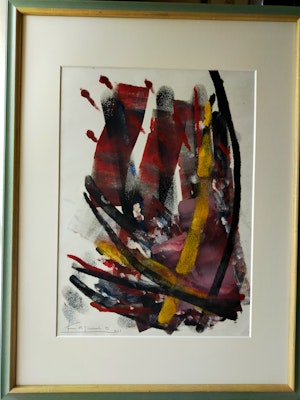
One of the defining qualities of acrylic paint is how approachable it is, even for beginners — and how universally it can be applied. Fast-drying and highly durable, it works not only on paper but on fabric, metal, glass, and other three-dimensional surfaces.
In recent years, the range of available colors has expanded dramatically — from soft, traditional Japanese-inspired tones to metallics and fluorescents. Sand can be mixed in for texture, or paste used to build up volume. The expressive possibilities are genuinely limitless.
My Process | Painting Fresh Flowers in a Single Session, Without an Eraser
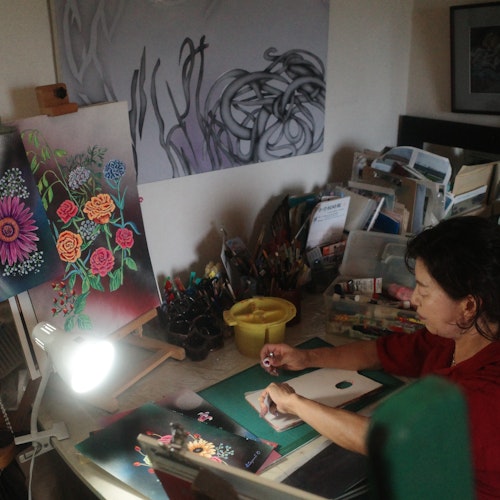
I paint fresh flowers, drawing on the vivid color and fast-drying qualities of acrylic paint. The most distinctive aspect of my process is that I never use an eraser — each painting is completed in a single, uninterrupted session. Using an eraser damages the acrylic ground underneath, so this constraint sharpens both my focus and the precision of every mark.
My process unfolds as follows: I begin by spraying acrylic paint to establish the spatial quality of the background. Then, with the flowers in front of me, I carefully render them in pencil. Once all the floral elements are drawn, I begin laying in broad areas of color with a wide flat brush, gradually switching to finer brushes as the painting moves toward completion. I use a paper palette for easy cleanup.
News

Blog

Contact